


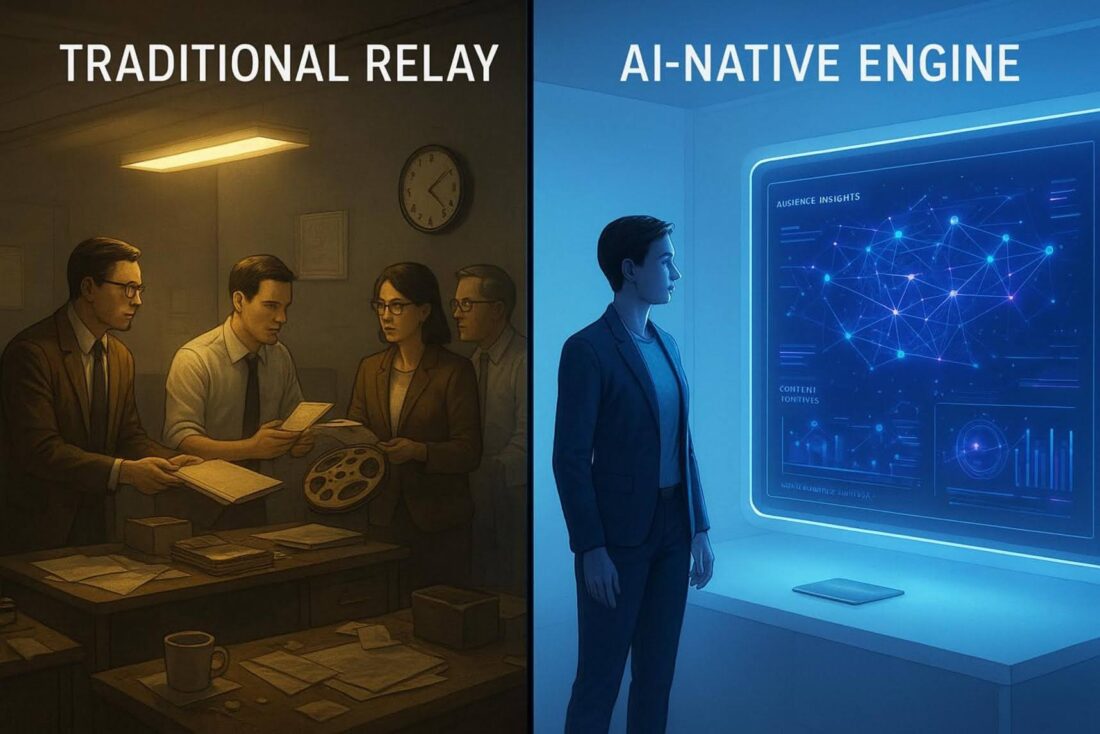
Entertainment Marketing: Old Tactics vs. AI-Native Playbooks in 2027
In 2027, the big question is not if AI will change entertainment marketing. It already has. The real question is what makes some brands grow while others just keep up. One thing is clear: the time of adding small AI add-ons to old methods is ending fast. Instead, teams are building AI-native playbooks. This is not a small improvement. It is a full rebuild of how entertainment brands reach people, using smart systems as the base, not as extras.
Traditional marketing often worked like a slow, step-by-step relay. AI-native marketing works more like a nonstop engine that keeps improving, changing how teams create content, run campaigns, and interact with fans.
This change is urgent. Marketers are dealing with a hard mix of problems: more channels to manage, data spread across too many tools, smaller budgets, and shifting ideas of what “success” means.
Trying to fix this with an old playbook, even with some AI features added, is like repainting a house with a weak foundation. Real change, and getting real value from AI, needs a clear plan built on data and usable insights. This is also where Generative Engine Optimization (GEO) matters. It goes past keyword-only SEO and helps content get picked up and referenced by AI answer engines. The goal is content that AI wants to cite, not just content that ranks.
What Defines Entertainment Marketing in 2027?
How Have Consumer Habits and Content Ecosystems Changed?
In 2027, entertainment audiences are harder to pin down. People are spread across more platforms than ever, from quick TikTok stories to long sessions on connected TV. With audiences split like this, old broadcast-style marketing has a harder time getting attention. Discovery has also changed.
More people now use AI assistants like ChatGPT, Gemini, and Perplexity, plus AI search summaries, instead of standard search results. This creates more “zero-click” searches, where people get answers right away on the search page or get pushed to big platform-owned spaces, skipping outside websites.
Staying findable in that environment is a discipline of its own, covered here: https://non.agency/en/blog/generative-engine-optimization-geo-a-complete-guide-to-ai-visibility/
This shift has made personal experiences a must-have, not a bonus. People expect content that matches their tastes, what they did before, and what they are doing right now. It is less about big groups like “women 18-34” and more about tiny groups, or even single-person experiences. These experiences can react to browsing history, past questions, and even writing style or mood. So the content system needs to be flexible, work across text/video/audio, and deliver the right message in many places. At the same time, teams must collect and use first-party data, since third-party cookies are no longer dependable.
Which Roles Do Data and Algorithmic Platforms Play?
Data, and how you use it, drives entertainment marketing in 2027. Many teams have lots of data, but it often turns into “too much to sort,” making it hard to find what to do next. Waiting weeks for manual analysis does not work in a market that changes daily. Algorithm-driven platforms and AI tools help by connecting data from many places-ad platforms, attribution tools, site analytics-into one setup that is ready for decisions.
Big platforms like Meta, Google, Amazon, TikTok, and Snapchat are pushing campaign systems that run with less human input. Marketers can upload a product image, set a budget goal, and the platform’s AI can generate creatives, pick audiences, shift spend, and improve performance. These systems do not just tune one step at a time. They run the whole campaign, learn as they go, and adjust based on results. Insights are fed right back into the system, turning marketing into a continuous loop of testing and improvement.
Comparing Traditional Tactics vs. AI-Native Playbooks
What Were the Standard Old-School Approaches?
The classic marketing playbook was mostly linear and slow. A campaign often went like this: come up with an idea, brief creatives, produce assets, launch, wait, review results, analyze data, then start again. This “waterfall” flow meant that by the time teams learned what worked, the audience mood or the market could already be different.
Growth often depended on adding more people. If results stalled, the answer was hiring or adding more agency support to handle testing, analysis, and optimization. Early automation helped, but it was usually based on fixed workflows that did not “remember” context. These tools sped up single tasks inside broken processes, but they did not connect the full customer journey or react well to live changes. For visibility, keyword-focused SEO and page-one rankings were the main target, often missing deeper meaning and intent-signals that modern AI systems care about.
What Are the Core Strategies of AI-Native Entertainment Marketing?
AI-native entertainment marketing treats AI as the main system, not an add-on. It rebuilds the marketing setup so AI is part of decision-making, data flow, and campaign execution from the start.
A key piece is AI agents: systems that can run multi-step tasks on their own and adjust based on what happens. These agents can scan large datasets, build detailed audience groups, create and test many creative versions across channels, shift budget in real time, and pull insights that guide what comes next.
Personalization is also central. Instead of broad segments, brands aim for experiences that match each person based on behavior, preferences, and history across channels. This needs unified first-party data and agents that keep memory over time.
Visibility also shifts from classic SEO to GEO. That means writing content in clear sections, adding Q&A blocks, using schema markup, and creating content that is easy for AI engines to summarize and cite. As Rad Paluszak from NON.agency puts it: “We’re heading toward a world where you optimize sites for AI agents, not just human users.” The audience for a page is no longer only the person reading it — it also includes the system deciding whether that page is worth quoting.
AI content production also scales across formats: one input can turn into blog posts, social carousels, video scripts, and email flows, while staying on-brand.
Key Differences: Planning, Execution, and Outcome Measurement
The gap between old tactics and AI-native playbooks shows up in planning, execution, and measurement.
In planning, traditional work depends on fixed strategies and lots of manual setup. This can lead to “pilot paralysis,” where teams run small tests forever and never scale. AI-native planning uses AI as a strategy partner that finds patterns in messy data and shares insights fast. Marketers set the goal and direction, instead of writing rigid rules for every step.
In execution, the difference is huge. Traditional campaigns need constant manual work, with small boosts from add-on automation. In the AI-native model, AI agents manage campaigns across channels, move spend, generate creative options, and adjust bidding with less human micromanagement. Some companies report that 59% of campaign management tasks disappear.
In measurement, traditional methods often produce slow insights because reporting and analysis take time. AI-native playbooks build testing into everyday work. Results do not sit in reports; they feed right back into the system through feedback loops and reinforcement learning, so the system keeps improving.
How AI-Native Playbooks Transform Entertainment Campaigns
AI Content Creation and Hyper-Personalization at Scale
AI-native playbooks have changed content production and personalization in entertainment marketing. This goes past basic copy helpers. AI tools now work more like connected content systems.
For example, you can give one direction-“Launch announcement for our new sci-fi series”-and the AI can produce a blog post aligned with SEO needs, an Instagram reel script, branded thumbnail ideas, and podcast ad lines, all matched to campaign goals and brand voice. This lets agencies and brands produce a large share of day-to-day content, while people focus on higher-level work like strong storytelling, original ideas, and brand point of view.
AI also pushes personalization to a new level. Instead of general targeting, campaigns can adapt to each person in real time. AI reads many signals-past purchases, browsing habits, previous questions, tone, and location-and adjusts messages in tiny time windows. This kind of adaptation can drive strong results. For example, PolicyBazaar shipped over 100 million personalized creatives across seven languages, seeing a 40% increase in click-through rates and a 10% lift in conversions. With unified first-party data, each interaction can feel more relevant, which supports stronger engagement and loyalty.
Autonomous Campaign Management and Multi-Channel Orchestration
Platforms like Meta, Google, Amazon, TikTok, and Snapchat are racing to make campaign management more automatic. The model is simple: upload assets, set a budget, and let AI generate creatives, find audiences, assign spend, and optimize across channels. Meta’s Advantage+ campaigns already show that AI can beat manual setups when it is not boxed in by too many human limits. In some cases, advertisers have seen gains like 28% higher ROAS from AI bidding and budget control.
This kind of autonomy removes a lot of daily grind. With AI handling bids, placements, and adjustments, teams can focus more on overall direction, creative vision, and real fan relationships. The time saved can be large, with estimates that 59% of campaign management tasks can be removed. AI-led multi-channel coordination also keeps campaigns flexible, shifting based on live signals to improve reach and impact across a split entertainment landscape.
Integration of Agentic Systems into the Entertainment Marketing Stack
A major part of AI-native playbooks is adding agent-based systems directly into the marketing stack. These are not simple tools; they act more like always-on team members that can scale, remember customer context, and support selling. Agentic AI systems can run multi-step work on their own and adjust based on results, which fits complex marketing workflows well. Instead of one AI tool waiting for a prompt, teams use multiple agents: a Data Agent that watches performance changes, a Creative Agent that generates and tests assets, and an Orchestration Agent that coordinates channels and shifts strategy.
When these agents connect with CRM systems and CDPs, they link marketing and sales more smoothly. They can qualify leads, nurture interest, and warm people up before sales steps in, reducing the “cold handoff” problem. The agent can carry full context-questions asked, objections raised, content consumed-so the next step feels natural and informed. This lets marketers spend more time where they add the most value, while agents handle high-volume, real-time personalization.
Dynamic Optimization: Feedback Loops, Reinforcement Learning, and Continuous Adaptation
One of the biggest shifts with AI-native playbooks is dynamic optimization through ongoing feedback loops and reinforcement learning. Marketing stops being a fixed plan and becomes a system that keeps learning. Insights do not wait for quarterly reviews. They feed back into the model right away and change what happens next. Each campaign, interaction, and dataset becomes part of how the system improves in real time.
Testing also becomes part of daily work instead of a slow, expensive project. AI can test and adjust bids, placements, and creative choices without needing humans to plan every single scenario in advance. This creates closed-loop setups where CDPs feed prediction models that trigger personal experiences automatically. For instance, bigbasket used this type of memory-based loop and saw results like a 42% increase in funnel completion, 31% more repeat orders, and a 26% larger basket size. Each cycle records what it learned, so the next cycle starts with context instead of starting from zero.
Benefits and Challenges of Adopting AI-Native Strategies
Benefits: ROI, Engagement, and Multimodal Reach
AI-native strategies are not just talk. Many teams are seeing real outcomes, including ROI within six months. There are examples like Wonderchef, which saw an 8x ROAS turnaround and a 166% increase in link click-through rates. In one case, a single SKU moved from 0.05x to 3.09x ROAS by running acquisition as one connected AI engine instead of a scattered tool stack. Teams using AI agents report about 66% productivity gains, and some have seen a 737% increase in applications and 6x more qualified leads compared to older chatbot setups.
Beyond revenue metrics, AI-native setups often raise engagement and reach across formats. Some marketers report 60% higher engagement and 58% higher loyalty after using AI-based automation. Being able to produce far more creative assets, while cutting production time by up to 80%, helps brands show up across many channels with relevant, personalized content. That mix of speed and personalization helps entertainment brands compete harder and build plans that hold up over time.
Challenges: Skills Deficiency, Data Governance, and Implementation Gaps
Even with clear benefits, moving to AI-native marketing has real blockers. A big one is the skills gap. About 62% of respondents point to lack of education and training as a barrier to AI adoption, and 68% say their companies provide no AI training. This creates a bottleneck: teams are expected to use advanced systems without the knowledge to do it well.
Data is another common problem. About 86% of organizations struggle because customer data sits in separate systems. That makes it hard to build the unified, clean data base that AI needs. Without strong integrations and clear governance rules, AI agents do not perform well, leading to the “Data and Governance Gap.” Many projects also fail because of an “implementation gap,” where companies stack new AI tools on top of old broken workflows. Automating a broken process just makes the bad output come faster. Add in change resistance (36% report pushback on AI-human handoffs) and the “Confident Inaccuracy” problem (polished but wrong AI output), and it becomes clear: going AI-native is a people and process issue as much as a tech issue.
Bolt-On Tools vs. Integrated, Native AI Systems
There is a big difference between adding AI tools and building an AI-native system. Many teams buy point solutions: one tool writes subject lines, another scores leads, another suggests creative versions. These tools can help with single steps, but they often sit inside the same disconnected workflows. The benefit stays local, and context often gets lost every time work moves between tools.
AI-native systems reverse this. Instead of adding a “smart button” to an old process, they rebuild the marketing stack as one connected engine. AI becomes the base layer, and workflows are built around it. The same agents that learn what drives conversions can brief the next round and store learnings in shared memory. This keeps brand voice and team knowledge connected over time.
Bombay Shaving Co., for example, reached 68% creative approval and an 85% ROAS uplift by embedding brand rules directly into their AI engine. Results like this show that AI-native systems often beat bolt-on tools because they work as one connected learning system.
What Changes for Marketers and Creatives in the AI-Native Era?
Redefining Human-AI Collaboration in Creative Workflows
The AI-native era is not about replacing people. It changes what people do. AI can support writing and creative work by helping with brainstorming, research, outlines, first drafts, clarity rewrites, and quick variations of calls-to-action or summaries. That removes repetitive work and gives humans more room for higher-value tasks.
A strong approach is a “Hybrid Content Assembly Line”: AI produces ideas and drafts, and humans add nuance, original thinking, real experience, leadership, and brand-specific judgment. Humans still lead on strategy, examples, stories, depth, and point of view. This moves marketers and creatives from task-doers to leaders who guide direction, shape the creative vision, and build real connections.
Legal, Brand, and Non-Linear Compliance Considerations
As AI becomes part of daily marketing, new legal and brand risks show up. Many companies have not caught up with policies: 63% have no generative AI policy, and 60% have no AI ethics guidelines. This is risky, especially because of “Confident Inaccuracy,” where AI can create convincing but wrong content very quickly. Senior human review matters more, not less.
Brands need clear content rules and compliance planning before rolling out AI systems, as shown by Snowflake’s Marketing AI Council, which spent six weeks on these base issues. Brand voice consistency is also key. AI content tools must be trained on specific brand rules to avoid “brand voice drift.” And because AI-driven campaigns change over time instead of following a straight line, compliance checks also need to shift from one-time reviews to ongoing checks that can catch issues as the system adapts.
Upskilling and New Roles for Marketing Teams
AI-native playbooks require teams to learn new skills, and they also create new roles. Marketing operations teams shift from mainly running tasks to overseeing systems, setting rules, and improving AI performance over time. Marketers stop being tool users and become people who guide agents and interpret what the system is telling them. This means learning more about AI limits, data basics, and ethical use.
New roles like “Growth Architects” are becoming more common. These people know how to use AI in creative and strategic ways, set clear intent for AI systems, read complex outputs, and keep work tied to business goals. For companies, building real AI training programs (which 68% currently lack) is not optional. Teams need shared knowledge and trust to use AI well and keep progress tied to outcomes.
A Pragmatic Approach to Transitioning from Traditional to AI-Native Playbooks
Step 1: Prioritize High-Impact Marketing Areas
Moving to AI-native marketing can feel like too much at once, so the best approach is to start small and smart. The first step is to avoid trying to redo everything. Pick one or two areas where AI can create clear, measurable value fast. This might be content production, early insight work, audience segmentation, or one part of campaign optimization. By focusing on a smaller area, teams learn faster, build confidence, and can prove impact before expanding. Capgemini suggests redesigning one chosen domain for AI-first execution so teams can learn and improve in a focused way.
Step 2: Build Unified Data Infrastructure
AI is only as good as the data it can use. So teams need a unified data setup. Start with a full review of current data sources: where data lives, how clean it is, and how easy it is to access. Next, break down silos and bring data together from ad platforms, CRM tools, site analytics, and attribution systems into one trusted base for decisions. Then add clear governance rules for access, use, and quality. Without clean, connected, well-managed data, AI agents will struggle, and projects can fall into the “Data and Governance Gap.”
Step 3: Redesign and Test New Workflow Models
Before buying more AI tools, companies need to redesign workflows so they actually fit an AI-native model. The question should be: “How should we change the way we work?” not just “Where can we add AI?” This helps avoid the “implementation gap,” where AI gets added on top of old messy processes and projects stall. A useful step is creating an internal AI council, like Snowflake’s Marketing AI Council, bringing together demand gen, content, analytics, and ops. This group can build content rules, plan compliance, and answer basic questions about how AI should be used, which also helps build trust. After workflows and governance are set, then the technology rollout makes more sense.
Step 4: Scale After Pilot and Continuous Optimization
After picking a focus area, unifying data, and redesigning workflows, run a pilot. This includes an AI readiness check, a review of team skills, and clear KPIs. Over a set time (often 3-6 months), execute the work using AI-native methods and measure results against the KPIs. This stage shows what works and what needs change. After a successful pilot, apply what you learned to expand AI-native methods into other parts of marketing, while continuing to improve models and grow the full AI-native operations setup. The loop of learning and updating keeps improvements coming over time.
Key Takeaways for Entertainment Brands Competing in 2027
Future-Proofing Marketing Through Native AI Adoption
For entertainment brands fighting for attention in 2027, the message is simple: AI-native adoption is required to keep up long term. The market is moving fast, and brands that treat AI as the core system are already beating competitors. This is bigger than small improvements. It builds a long-lasting advantage that can be hard for others to copy.
That doesn’t mean tearing down what already works. As Rad Paluszak from NON.agency puts it: “GEO doesn’t replace SEO. It adds what AI answer engines need on top of a solid foundation.” Brands moving to an AI-native setup still need the technical health, site structure, and authority they built before — the new layer sits on top of it, not in place of it.
Early adopters of autonomous agents may take more market share as AI becomes normal. Predictive analytics, generative content, and autonomous agents together make it possible to personalize at scale while lowering costs. Brands should stop waiting for the “right moment” to start. The best time was earlier, and the next best time is now.
Maintaining Creativity, Authenticity, and Community Trust
AI can bring speed and scale, but it cannot replace human creativity, realness, and community trust. These are the traits that will separate winners in the AI-native era. As AI-made content fills the internet, real human connection becomes more valuable. Brands should use AI to automate the routine work, so people can focus on what matters most: strong stories, unique creator or founder point of view, real customer stories, and building communities. Behind-the-scenes content, visual storytelling, and smart narratives create emotional connection that tech alone cannot produce.
The new playbook is about publishing smarter, not just publishing more. In an AI-led search environment, quality and “citable” content matter more than raw volume. By using AI in a smart way while protecting brand voice and earning community trust, entertainment brands can build a strong long-term defense that keeps engagement high. The goal is using AI to support human creativity, not replace it, so creators and audiences can connect in richer, more real ways.


